
Gemini 4 Neon Matches Opus 5.5, Then Overthinks a CSV Parser
Gemini 4 Neon matched Claude Opus 5.5's answers in one developer's tests and beat it on a long search. It also used nearly eight times the thinking on a small coding task. Who should move, and which settings matter.
Gemini 4 Neon is Google's new middle model, released on 18 November 2026. It sits between Hydrogen and Carbon, and in the Gemini app it has taken Argon's place. Hacker News called it an Opus 5.5 competitor, so here's the question: if Claude Opus 5.5 is your daily model, should you move?
Same answers as Opus 5.5 in Flavio Copes' tests
Developer Flavio Copes ran Neon, Carbon and Opus 5.5 at high effort through two coding tasks (a duration parser and a CSV parser) and a commit-message rewrite. All three passed every case.
Artificial Analysis agrees they're close: Neon scores 60 on its Intelligence Index at the default high setting, and Opus 5.5 at max effort scores 59.
5,495 thinking tokens for a CSV parser
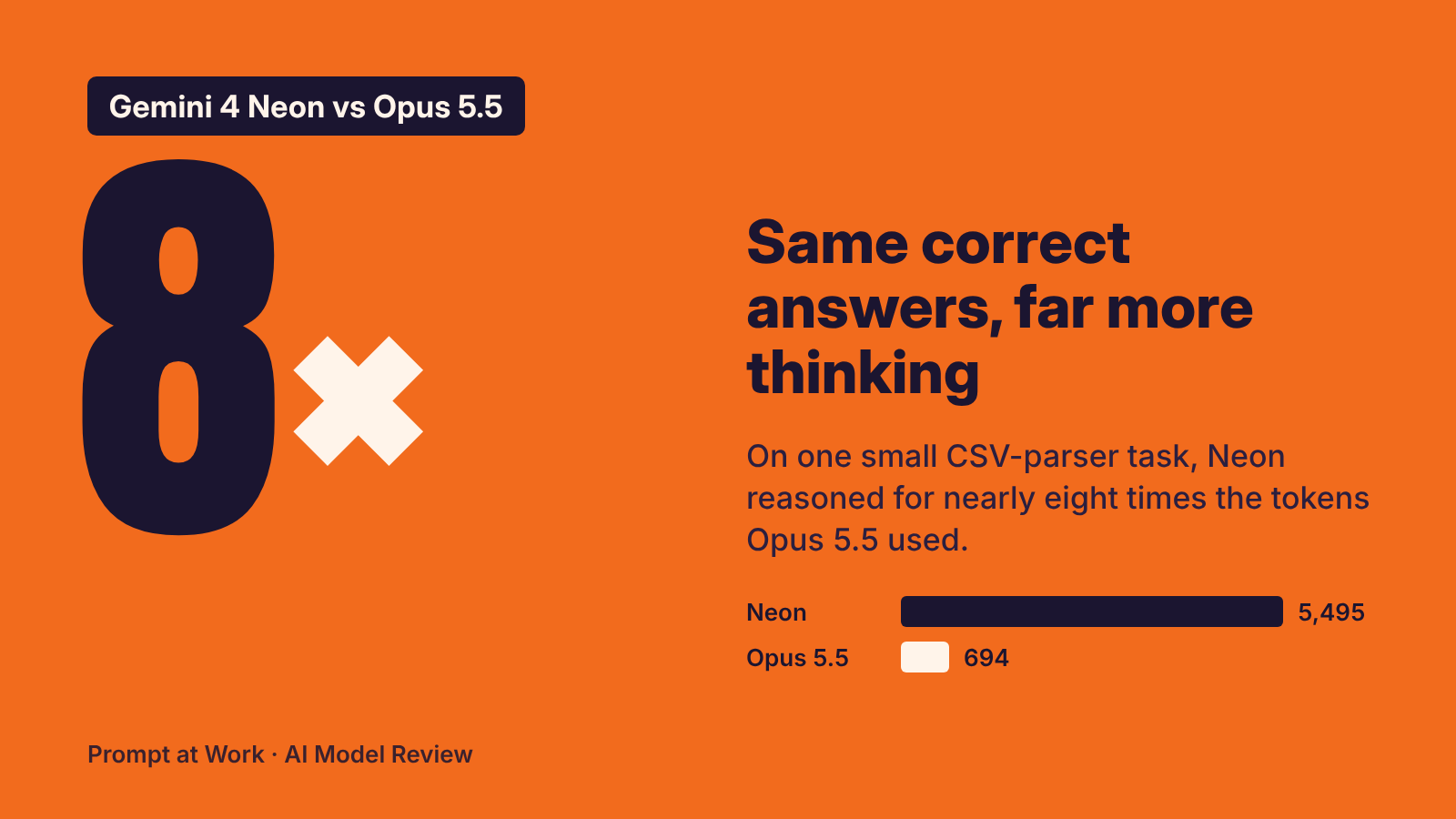
The difference is how long Neon thinks. On the CSV task it reasoned for 5,495 tokens before answering; Opus used 694, about an eighth as many. Neon took 49 seconds where Opus took 12.
Artificial Analysis calls Neon "very verbose": about 123 million output tokens to finish its index at high, against a median near 65 million.
The fix is the thinking level. Copes dropped Neon to low on the same CSV task and it still passed all 27 cases. Google's developer guide agrees: low for summaries and routing, medium for general coding, high for multi-step agent work, xhigh only for the hardest multi-file jobs.
Where Neon pulls ahead: a 103,000-token search
Copes also handed both models 23 of his blog posts, about 103,000 tokens, and asked for the two that matched a query. Both found them, and Neon's run cost about 40% less than Opus's.
Google's vendor-reported GraphWalks scores, a test of following connections through up to 1 million tokens of text, put Neon at 95.2 against 66.8 for Opus 5.5. Long contracts and research folders are Neon's best case, and Pro subscribers get the full 1 million-token window in the app, roughly 7.5 lakh English words.
Argon was better at saying "I don't know"
Argon's low guessing rate was the headline of my Argon review, and Neon gives some of that back. AA-Omniscience counts how often a model answers wrong when it should have admitted it didn't know, and eesel's reading of Artificial Analysis data puts Neon (high) at 14%. Argon (high) and Carbon (medium) sit at 4%.
Opus 5.5 at max is listed at 50%, so for a Claude user this is a point in Neon's favour. Argon users should start checking names and figures again.
Its knowledge stops in March 2026; one reported test had it coding against a Fitbit API Google had already shut down. Paste current docs for anything recent.
"Deeper analysis: 4 Neon" in the model picker
In the Gemini app, open the model drop-down. 9to5Google lists the new labels: Everyday help is Hydrogen, Deeper analysis is Neon, Code & complex work is Carbon, and Argon is gone. Neon needs Google AI Pro or Ultra; Free and AI Plus don't get it.
Google publishes no Neon-specific message limit, and I couldn't confirm an in-app thinking-level control, so the low and medium advice above is for AI Studio and the API.
Before you paste client work: the app can use your chats to train Google's models while Gemini History is on. Turn it off at myactivity.google.com/product/gemini. Chats are still kept for about two months, and any picked for human review stay for up to three years.
Antigravity makes Neon the default, with early capacity errors
On eligible plans, Antigravity now opens new conversations on Neon. One early tester logged 57 capacity errors and 4 stalled runs in 13 sessions, per Latent Space, and several Hacker News developers said they still trust Claude Code more for real projects.
Four developer settings that changed from Argon
- The default is now HIGH. Argon defaulted to medium, so set thinking_level to MEDIUM explicitly if your app relied on that, or waits and bills both climb.
- Temperature is ignored, as are top_p and top_k. Steer with thinking_level and a response schema.
- Explicit caching is gone. Caching now happens automatically on shared prefixes of 4,096 tokens or more, so put fixed instructions and documents first.
- Answers stop at 65,536 tokens unless you switch on background mode in the Interactions API.
One bonus: Neon reads Word, Excel and PowerPoint files directly.
Gemini 4 Neon quick facts
- Released 18 November 2026; API name gemini-4-neon; knowledge up to March 2026.
- 1 million-token context, shared by your input, its thinking and the answer.
- Gemini app on AI Pro and Ultra, plus AI Studio, Antigravity and Gemini for business.
- No free API tier; $3 per million input tokens and $15 per million output.
How I'd split work between Neon and Opus 5.5
I wouldn't cancel Claude, but I'd stop treating Gemini as the backup.
- Long documents and research folders: Neon at high.
- Short, well-defined code changes: Opus 5.5, or Neon dropped to low.
- Multi-day coding projects: Claude Code, until Antigravity's capacity errors settle.
If you already pay for Google AI Pro, Neon is the reason to open the Gemini app again. I wouldn't buy Pro just for it while Opus 5.5 is doing the job.
Comments
Comments are reviewed before they appear publicly.