
What You Gain and Lose Moving From ChatGPT to Gemini 4 Argon
Gemini 4 Argon is Google's new top model, with one of the lowest made-up-answer rates in independent tests. If you live in ChatGPT, here's what moving gets you, the settings to change first, and where it still falls short.
Gemini 4 Argon is Google's new top model, announced on 30 September 2026 and opened to Google AI Pro and Ultra subscribers in the Gemini app on 13 October. Developers get it through the paid Gemini API as gemini-4-argon.
This review is for someone who works mostly in ChatGPT and wonders whether Argon is worth moving for.
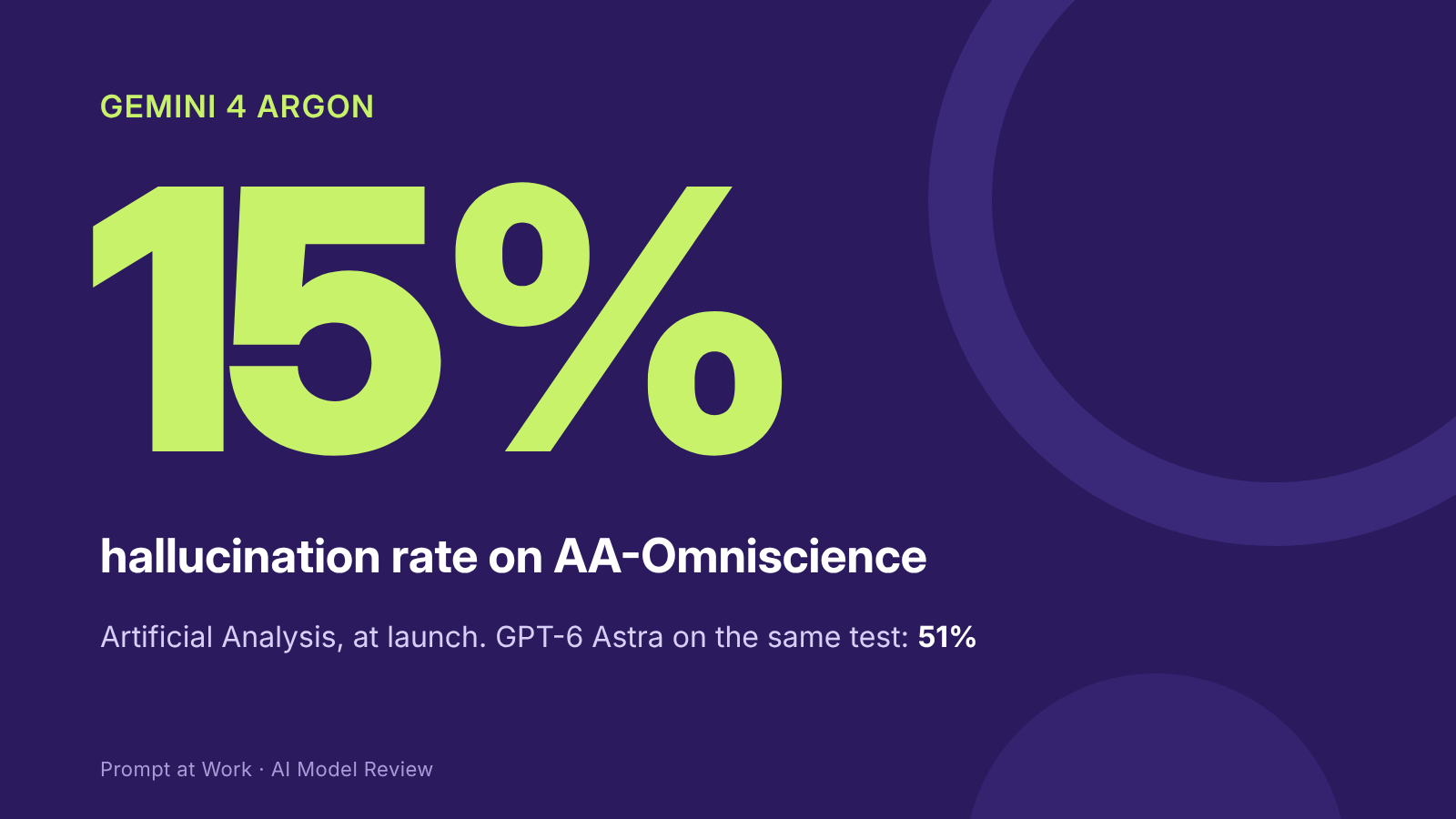
What you gain: a 15% hallucination rate on AA-Omniscience
Artificial Analysis, an independent testing group, measured Argon at launch with a 15% hallucination rate on its AA-Omniscience test, against 51% for GPT-6 Astra. When Argon didn't know, it usually said so instead of inventing an answer. The trade-off: 50% correct answers against Astra's 63%.
On LMArena's blind-vote text leaderboard, Argon (high) is second with 1520 points, behind only Gemini 4 Carbon, which most people can't use yet. For research summaries and client notes, where a confident wrong fact costs you, that is the strongest reason to switch.
The Thinking level menu decides how fast your quota goes
This is the setting most new users skip. In the Gemini app, open the model menu at the top, pick Argon, then choose a Thinking level: Low, Medium or High. Google's developer docs make Medium the default and tell you to use the lowest level that meets your bar.
High is expensive. Pro subscribers on r/GeminiAI reported one email rewrite using 18% of a five-hour allowance, and Google publishes no Argon prompt count for any plan, only that limits are "compute-based". On the API, Artificial Analysis clocks the first word at High after about 41 seconds.
One tester built the same browser game at all three levels; High took about twice as long as Medium and added polish, not fewer bugs. My default: Medium for work, Low for quick questions, High only when you'll walk away anyway.
Task mode: give Argon a goal and close the laptop
Tap Task above the text box, describe the goal and, if you like, when it should run. Argon plans the steps, shows them in a progress chip and pulls from Gmail, Drive, Calendar and Sheets through Connected Apps. A task on Google's remote browser keeps running after you close the device.
Two details people miss: up to 15 tasks can run at once, and stopping only the Chrome browsing may let Gemini try another route, so press Stop in the text box to cancel properly. Work and school Google accounts can't use tasks yet.
Task mode needs Keep Activity, which means training
To use tasks, Google requires Keep Activity on and an opt-in to Personal Intelligence. Its privacy hub says that with Keep Activity on, your chats help train its generative models, some are read by human reviewers, and activity is kept 18 months by default (you can cut that to 3 at myactivity.google.com/product/gemini). If a chat holds client data, switch Keep Activity off and give up tasks for that work.
Where ChatGPT and Claude still win: coding and short answers
Google's own launch table shows Argon behind GPT-6 Astra on FrontierSWE v2 (55.0% against 65.5%) and behind Claude Opus 5.5 on Terminal-Bench 4.0 (57.4% against 66.4%). A 16 October thread on Google's developer forum called its coding "underwhelming".
It also talks a lot: Artificial Analysis counted 110 million output tokens to run its index, against a median of about 73 million, which is part of why quotas drain. Another forum post says audio uploads weren't recognised in the Gemini web app; I couldn't confirm a fix.
Developers: gemini-4-argon ignores temperature
Moving code over? Argon ignores temperature, top_p and top_k, and explicit caching is gone. With background mode on it can write up to about 1M tokens in one answer, up from 64K for older Gemini models, so raise client timeouts to at least 15 minutes.
Argon at a glance
- Context window: 1M tokens, about 7.5 lakh English words, shared between input and output.
- In the app on Google AI Pro (₹1,950 a month in India) and Ultra; not on free Gemini.
- API: $2 in and $10 out per million tokens until 30 November, then $4 and $20.
Move to Argon if your work is research, reports or long documents where a made-up fact is the real risk, and you'll use Task mode with your Google apps.
Stay on ChatGPT or Claude if most of your day is coding, you use a work Google account, or you can't keep chats out of training.
Comments
Comments are reviewed before they appear publicly.