
What the Eleven v4 Leaderboard Misses About Cloned Indian Voices
Eleven v4 tops the English voice leaderboard, and its Turbo version sits just above it. A hands-on test, the new accent rules for cloned voices and a missing Speed slider show which settings to change first.
Eleven v4 is ElevenLabs' newest text-to-speech model, released on 28 September 2026. It comes in two versions: Eleven v4 for voiceovers, audiobooks and dialogue, and Eleven v4 Turbo for live voice agents, with median inference latency of about 100 milliseconds by ElevenLabs' count. Both cover more than 90 languages, up from about 70 on v3.
The launch post said "ranked #1". That holds, with footnotes most reposts skipped, and those footnotes point to the settings worth changing.
1,330 Elo for v4, and 1,335 for Turbo
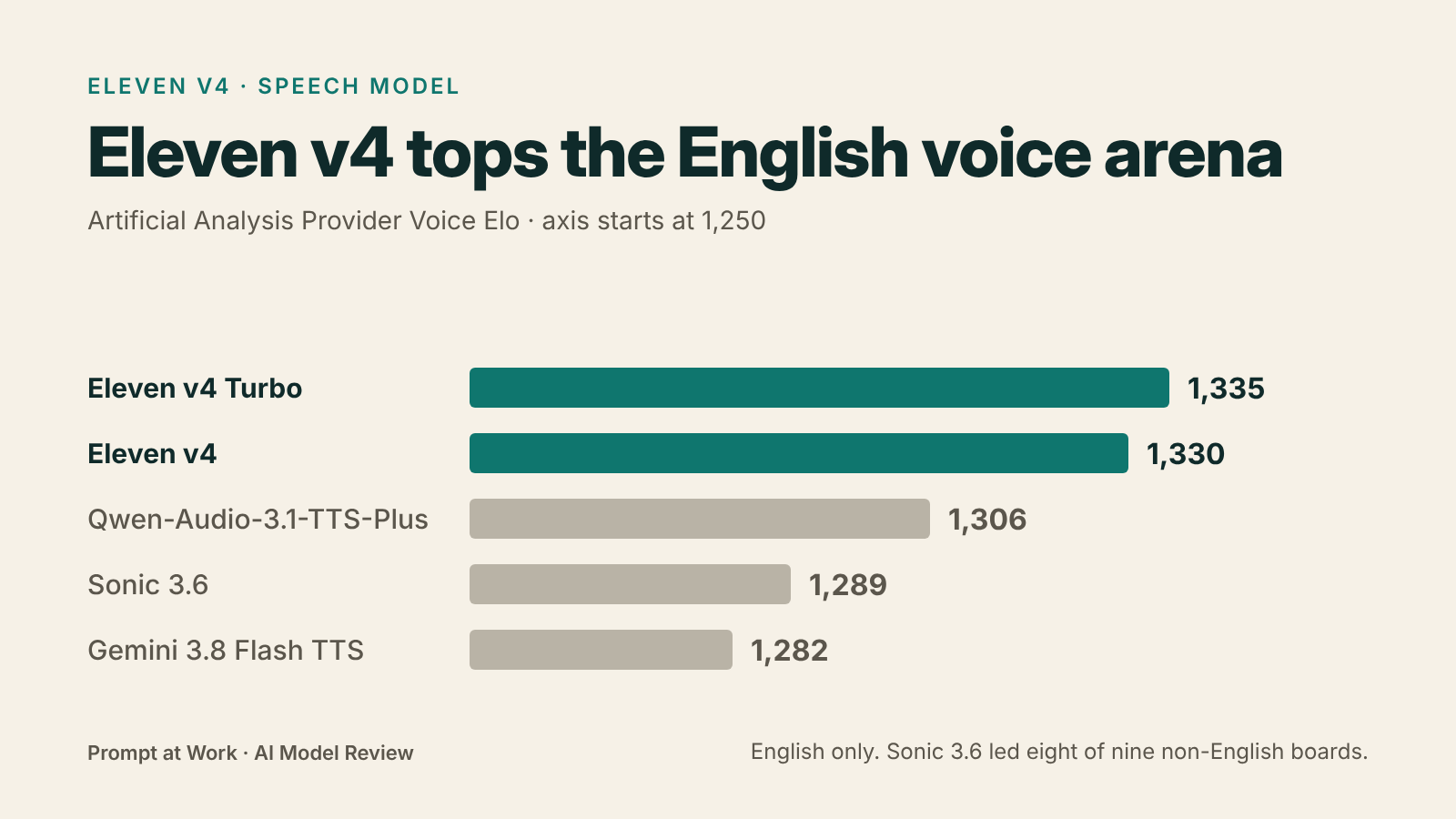
On the Artificial Analysis Provider Voice leaderboard, where listeners vote blind between two clips, Turbo sits first at 1,335 and v4 second at 1,330. Next come Qwen-Audio-3.1-TTS-Plus (1,306), Cartesia's Sonic 3.6 (1,289) and Gemini 3.8 Flash TTS (1,282). The top two overlap within their confidence ranges, so I'd call them tied.
This board tests stock voices in English. AlphaSignal's launch-day report noted that on the arena's nine non-English boards, Hindi among them, Sonic 3.6 still led eight. Pronunciation scored 91.7%, up from 85.6% for v3, but only 78.8% on exact character sequences like codes and serial numbers.
Ritza's hands-on test: numbers yes, clones no
A tester at Ritza ran Eleven v4 against Gemini 3.8 Flash TTS in early October: English only, one listener, default settings. Small, so I treat it as a checklist.
- Hard text went to v4: it read an order number, a date and an Irish name correctly, and held a 2.5-minute narration steady.
- Cloning went to Gemini: the v4 clone laid a heavy British accent over the tester's South African voice in all three lines.
- Phone numbers tripped v4: it read every zero aloud. ElevenLabs' own model guide still sends number-heavy text to Multilingual v2.
A voice cloned in Hindi will speak English without your accent
This part is deliberate. ElevenLabs' v4 page says the accent is kept when you generate in the language of the original recording. In any other language, v4 aims for fluent, native-sounding speech and drops the source accent. A clone recorded in Hindi, reading an English script, won't sound Indian by default.
ElevenLabs calls an accent toggle a research project with no timeline. Its prompting guide offers an experimental tag, [strong X accent], with Indian in place of X, though experimental tags vary from voice to voice. My simpler fix: record your clone sample in the language you publish in most.
Clone Strength appears only for a Professional Voice Clone
Professional Voice Clones, trained on a longer recording, start on the Creator plan. On v4 they get a Clone Strength slider: lower values give the voice more room to act, higher values stay closer to the training audio, which helps distinctive accents. ElevenLabs suggests starting at 0%.
An older clone doesn't move to v4 by itself. Open My Voices, hover over the voice, and click the plus button next to Eleven v4 to fine-tune it. ElevenLabs warns that a v4 clone may sound quite different from its v3 version, and that v4 copies plosives, clipping and volume jumps from the source, so a clean re-recording can beat any slider.
No Speed slider on v4, so pacing goes in the script
Two ElevenLabs pages say v4 has no Style or Speed slider and ignores SSML, the markup older scripts used for pauses. (Its general settings guide still lists a speed control, so check your own screen.) One creator quoted by eesel called v4 too theatrical for restrained voices. What works instead:
- Lower Stability for a more expressive read, or raise it so every lesson in a course sounds alike. The guide suggests starting around 50.
- Add an ellipsis for a short beat, or a pause tag such as [short pause].
- Press Enhance, which uses an AI model to add audio tags without changing your words, then delete the tags you don't want.
Eleven v4 specs, briefly
- Where: the ElevenLabs web app, ElevenAgents and the API (eleven_v4, eleven_v4_turbo).
- Length: 10,000 characters per generation on v4, about ten minutes of audio.
- Privacy: uploads may train ElevenLabs' models unless you're on Enterprise; switch off "Improve the models for everyone" under profile, Terms and privacy, Data use.
- Price: free account with 10,000 credits a month; API v4 at $80 and Turbo at $40 per million characters.
My three-script test before moving a channel to v4
Run the same voice on your current model and on v4 with three real scripts: a long narration, a two-person dialogue, and one full of names and numbers. Then listen for whether the clone still sounds like you, whether the accent survived, and whether tags landed where you put them.
I'd move narration and course audio to v4 now, since steady long-form reading is where the arena and the hands-on test agree. For your own clone speaking a second language, I'd wait. A fluent stranger reading your English script is worse than a slightly flatter v3 take.
Comments
Comments are reviewed before they appear publicly.